 Pumping Machinery Consulting and Training
|
|
|
Course Description: "CENTRIFUGAL AND POSITIVE DISPLACEMENT PUMPS: Theory, Applications and Hands-On" by
Dr. Lev Nelik, P.E. Cell +972-50-865-0451
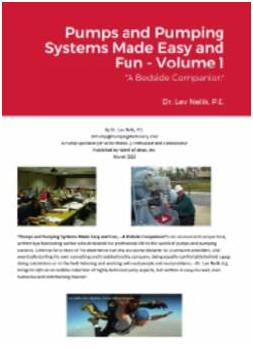
Introductory price (books just published): “Pumps and Pumping Systems, made Easy and Fun, Volume 1: “A Bedside Companion”, $59.95 a) “Pumps and Pumping Systems, made Easy and Fun, Volume 2: “For the Perplexed”, $59.95 b) “Pumps and Pumping Systems, made Easy and Fun, Volume 3: “For Those Who Still Would Not Quit”, $59.95
* At a special introductory price (books are just coming out): 3 volumes together for $150.
“Pumps and Pumping Systems Made Easy and Fun, - A Bedside Companion” is an unusual and unique book, written by a fascinating author who dedicated his professional life to the world of pumps and pumping systems. Covering forty years of his experience starting as a pump designer to a company president, and eventually starting his own consulting and troubleshooting company, being equally comfortable behind a desk doing calculations or in the field listening and working with real people and real problems, - Dr. Lev Nelik, P.E. brings to light an incredible collection of highly technical pump aspects, but written in easy-to-read, even humorous and entertaining manner.
Volume 1 (“A Bedside Companion”):
Introduction 1. Pumping Industry Overview – a Historic Perspective over the years 2. Pump Hydraulics – without getting a Ph.D. or a headache 3. Pump Performance – and who can be fired 4. Cavitation – what does it Really mean (to my job security) 5. Focus on Fundamentals – what else is there anyway? 6. Positive Displacement Pumps – positively a negative approach 7. Submersible Pumps and Wastewater niceties 8. Parallel Operation – let’s pull together 9. Design Aspects – and Suspects 10. Specific Speed Ns, and how specific is it really 11. Pumping Systems – a non-systematic approach Afterword (and aftertaste) Bibliography and Acknowledgements
Volume 2 (“For the Perplexed”):
12. Energy and Efficiency – can you buy an extra car for the money saved? 13. Reliability Aspects – how reliable is the rumor that it even matters? 14. Materials of Construction – a constructive destruction 15. Alignment and Installation Practices – can a pump just align itself? 16. Vibration and Noise Analysis – Loud and Clear
Volume 3 (“For Those Who Still Would Not Quit”):
17. Repair Techniques, Upgrades, and Industry Spec – to keep you awake at night 18. Motors and Other Drives – driven by sheer enthusiasm 19. Bearings and Lubrication – I cannot bear to take the load 20. Seals and Packings – who needs them anyway? 21. “MacGyver Specials” – what to do when only a hammer is available
After having spent over forty years with pumps, having published numerous articles and books, I came to a conclusion that there is more to life than just pumps. Having sacrificed dinners with family and having traded gardening for writing pump papers, reviewing vibration data from a recent pumping system troubleshooting trips, and all-in-all being essentially a happy slave for a company (at first someone else’s and later my own), I decided to take a new look at life. Can pumps be taken less seriously, yet still with good attention, care, and diligence – to make it fun to read and fun to learn? Does one need to walk away from a leaky packing without having nightmare worries later about not having tightened a packing gland? Will a failed bearing really put an end to civilization on earth, or perhaps life would still go on?
And so I decided to write a book that would be easily available – and more importantly – interesting and exciting, - not just for a few dedicated pump experts, but to a greater audience of folks, who – just like me – also have families, hobbies, and come home every evening to sit at a dinner table, and talk to their wives about how beautiful she looks, instead of how many impeller designs did I see earlier in the day at the warehouse of a wastewater pumping station.
It then dawned on me that I do not really need to write anything new – but simply take whatever I already produced over forty years and look at the same stories at a lighter angle, with some humor and fun – yet, without losing the integrity of technical side of the subject. Some of my work had been published in, what is called, “archival sources”, such as a Journal of Fluids Engineering, of which I used to be an Associated Technical Editor, or an Encyclopedia of Chemical Technology, for which I wrote a section on pumps, or a Pump Handbook to which I also contributed with a section. I decided to add references to these publications at the end of the book but not use these publications themselves in order not to detract from a “fun side’ of a book. The material I left included to make the bulk of this book was mostly articles consisting of just a few pages, and covering very practical, “what to do”, types of situations and problems commonly encountered in water plants, chemical plants, power stations, paper mills, refineries, and other places, - but written for regular folks – humans - maintenance managers, plant engineers, operators, and others – who value reliability and want to save energy and money for their plants – but without sacrificing family lives and divorcing their wives in order to become married to work.
And so, the format of the book became just that – facts, technical integrity, but with an air of fun, realism, and appreciation of a need to smell not only wastewater at work but also flowers at the home garden. The articles are thus reproduced just as their appeared as published, without deleting any ads, notes, marks, or whatever other not directly related material might be on the printed page. It made it look less “fancy” – but simple and “just-the-facts”! – and it also made the book less expensive (a good thing) making it more affordable by drastically reducing publishing and editorial work (it does not compete for a “Noble Price in Artwork”) but it added a flavor of simplicity and reality. Before each article or each section, I added a few short notes, just to summarize what the reader is about to read, and why he should not worry if he or she still remains as lost about mechanical seal basics as he or she was before reading the article. Hopefully, such a book will find a much broader audience to become a “coffee table book” even at home, to not only learn but also to do a bit of a laugh-abouts.
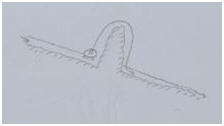
As a final note in the introduction, I would like to share an interesting experience at the wastewater processing plant many years ago, which had (and still probably has) less to do with pumps but with the overall management (or perhaps mismanagement) approach to basics. As you might know, wastewater processing plants take incoming raw sewage and process it thru several stages, treating it mechanically, chemically, biologically, etc., to ultimately discharge it to a river, lake, or other sources in a clean stage – usually even cleaner than the natural water in rivers. The overall grade of such a typical plant is such that there would be a natural flow from the entrance to the ultimate discharge. It would obviously be illogical to construct the plant “backward” – against the natural current, so to speak. At the plant I saw, all was mostly well – the site had a gradual slope, and water flowed naturally – except that in the middle of the plant there was a relatively small hill – with its top above the entire plant. If the hill was simply excavated away during the initial construction of the plant, the water would naturally flow (like a river) from the entrance to the plant to the exit. However, excavation would cost an additional 5% or so to the plant cost, and thus it was decided to install a pumping station (a “less expensive option”) at the bottom of the hill to pipe and pump the water over it, and then it would continue flowing on to the exit. Needless to say, from the onset on, the plant had thus set itself for eventual problems with the pumping station, instead of not having the station there, to begin with. Pennywise and dollar foolish is apparently an occasional (or perhaps more than occasional) approach some nincompoops decide to follow.
And thus, a lesson I learned, as a pump professional – before you begin fixing it, ask yourself if it can simply be eliminated! Keep it simple. More common sense. Do not complicate this game. Enjoy life!
Live and learn.
Dr. Lev Nelik, P.E. Technical Director International Center for Pumping Machinery Research and Development SCE College of Engineering Atlanta, USA - Beer Sheva, Israel 84746 cell +972-50-865-0451 email DrPump@PumpingMachinery.com You receive 1.8 Continuing Education Units (CEU) and qualify for 15 Professional Development Hours needed to fulfill Professional Engineers’ continuing education requirements in many states.
Note: Open School class in Atlanta starts 8 am thru 4 pm, both days. For on-site classes, the starting and ending times are determined as best fits the hosting company (typically 7:00 am thru 3:30 pm).
Level I (BASICS) Course Description and Audience (for Advanced, Level II, scroll further below)
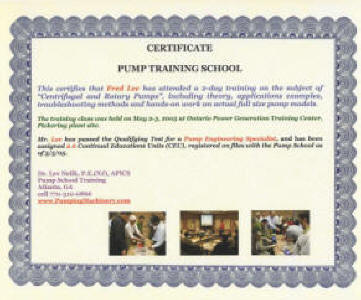
This 2-day action-oriented course is prepared for maintenance personnel, engineers, equipment reliability leaders, plant operators, purchasing and facility management who are involved with pumps, and want to get a better understanding of pump designs, application-related differences between the pump types, as well as obtain a practical and unique hands-on reassembly experience to supplement the theory. The course provides an opportunity to review, refresh and enhance the attendants' pump knowledge, and to learn the latest pump technologies to help solve their specific problems. It also provides an opportunity to interact, learn from the instructor and from each other, and to implement the troubleshooting techniques at the facilities immediately following the training.
The course will introduce participants to the different types of pumps and their associated terminology. Centrifugal and Positive-Displacement pumps, packing, mechanical seals and sealing systems, bearings and couplings will all be discussed. The application of the different types of pumps will be discussed along with their suitability for different operational duties. Pump operation, troubleshooting and maintenance will be dealt with in depth. Pump to motor alignment, effect of piping loads and energy savings through efficiency improvement and identification of the regime of operation to avoid problems present practical and immediate opportunities for implementation at the plant level. Actual testing of live pumps is conducted by the attendees in class, and the obtained performance curves are plotted. The course will also benefit anyone who wishes to update themselves on pump technology, judge the suitability of different types of pumps for their needs, and learn how to operate and maintain them for the benefit of their organizations. A hands-on part of the course is a unique opportunity to "get hands dirty" and to see, firsthand, the internals of the equipment, which they otherwise might have only seen on drawings, specs and books. Conversely, plant mechanics and maintenance people will get an opportunity to put the theory, the "why’s and what’s", behind their practical knowledge. Every attendee thus will walk away with something new, specific and helpful for their personal development as well as immediate benefits to their companies. Objectives At the end of this course participants will:
Prerequisites The attendees should have some basic knowledge of machinery, such as pumps, or mixers, motors, turbines, etc. Dress casual, prepare to work with tools, although no heavy lifting. Bring a calculator. Special Features In additional to theory and hands-on reassembly work, the participants will be testing pumps, obtain and plot H-Q curves using a single centrifugal seal-less mag-drive pump, and then two pumps operating in parallel. Assessment Measures A self-check List-of-Learning is provided. By answering a 1-page questioner at the beginning of the course and comparing with same at the end of the course, each participant will be able to do a self-evaluation summary of his or her accomplishments during the course. Key Benefits The knowledge gained in this course will:
Training Methodology The course will be conducted along workshop principles with formal lectures, case studies and interactive hands-on work. Relevant case studies will be provided to illustrate the application of each tool in an operations environment. Each learning point will be opportunities for discussion and sharing experiences. Organizational Impact On completion of this course the attendee will be able to critically analyze the methodologies employed within the Organization and instigate improvements where required. Personal Impact Technical knowledge is key to effective control and peer respect within any maintenance organization; when this is achieved personal satisfaction follows. This course will give the attendee the required level of technical knowledge and skill to achieve that personal satisfaction and professional growth. Competencies
Fees (see web updates): includes 300-pages set of Course Notes. Class size is limited, early registration is recommended. With questions, registrations and directions please call or email at address above. Changes, Cancellations, Refund Our facilities' arrangements and pre-planning, events reservations, transportations of course materials, printing of books, and similar logistics require us to make long term advanced planning of training seminars. This make it difficult to allow refunds. In the event you can not attend the training, our policy allows the following options: a. You can send a qualified substitute(s) b. If no substitute is available, for special circumstances (death in a family, inclement weather, work strikes, or an agreed upon special arrangements), we can allow one free switch-over to any training within the next (12) months c. You can apply the registration fee toward the training to be scheduled for a group, on-site, at your facility, within the next (24) months Course Content (Level I: Basics, 2 days)
Introduction
Centrifugal Pumps
Positive Displacement Pumps
Seals and Bearings
Reliability
Application Criteria and Specific Parameters
Course Content (Level II: Advanced, 3 days) Day 1 8:00 – 8:30: Introductions 8:30 - 10:00: Hands-on exercise (roll up your sleeves!) * disassembly and reassembly of a centrifugal pump including: * mechanical seals proper setting: component design versus cartridge (do you (still) remember how to set the spring tension?) * setting proper impeller front clearances and the energy/efficiency penalty on incorrect clearances ("how much?") * bearings and lubrication: oil, grease, forced lubrication, oil mist - which is best, most practical, ("it depends") ? 10:00 – 12:00: Detailed example of a hydraulic system - friction losses, elevation head, pipe size variations - class exercise 12:00 – 13:00: lunch 13:00 - 15:30: Live Performance Test of a centrifugal pump - one pump versus two pumps in parallel (will the flow double?) * generate actual pump curve and review operation of two pumps in parallel * Flow - Head - Power - Efficiency Day 2 8:00 – 10:00: Suction Side performance - live testing: * NPSHR versus NPSHA evaluation * minimum submergence (cavitation versus air entrainment) - which is more problematic or damaging? 10:00 – 12:00: Vibration analysis presentation using a multi-channel analyzer live demo * 3-channel analyzer shows live Acceleration (g), Velocity (V) and Displacement (D), in both time trace and frequency FFT live signatures * data acquisition hardware, software, 3 accelerometers (probes), and a PC computer - complete system presentation for immediate live data acquisition and analysis applications 12:00 – 13:00: lunch 13:00 - 14:00: Pump Types and Fundamentals Overview (how much did you forget?) * "Discharge Side": Performance (flow - head - power - efficiency) * "Suction Side": cavitation, NPSHA/NPSHR, recirculation, damage minimization efforts * Specs: ** HI ** ANSI and ISO ** API-610 ** PIP 14:00 – 15:30: PREMS-2A (Pumps Reliability and Efficiency/Energy Monitoring System setup and operation * on-line continuous monitoring of pump performance (actual live versus expected (OEM) curves, and vibrations/temperatures monitoring including spectral analysis FFT * hardware, software, probes (transducers, ultrasonic flow meter, CT transformers for power, accelerometers, and local/direct display versus internet connection options) * Hands-on efficiency testing of a centrifugal pump (to compare versus PREMS automated test at Day 1) Day 3 8:00 – 10:00: hands-on exercise: field balancing of rotors (finding location and magnitude of the unbalance, and applying trial weights method to compensate and balance) 10:00 – 12:00: Pump Operating Point (POP) and Best Efficiency Point (BEP) - why are they not the same? * efficiency prediction computer program * Affinity Laws 12:00 – 13:00: lunch 13:00 – 14:00: Performance modification methods - class exercises (actual example) * Affinity Laws (impeller trim, VFD speed change, customized impeller redesign (within the same casing) * Pumps Reliability and troubleshooting aspects 14:00 – 15:30: Positive Displacement Pumps 15:30 – 15:45: Q&A and Adjourn Course Instructor
Dr. Nelik is an Editor of Pump Magazine, an Advisory Board Member of Water and Wastes Digest, Editorial Advisory Board Member of Pumps & Systems magazine, and a former Associate Technical Editor of the Journal of Fluids Engineering. He is a Full Member of the ASME, and a Certified ASPICS. He is a graduate of Lehigh University with Ph.D. in Mechanical Engineering and a Masters in Manufacturing Systems. He teaches pump training courses in the US and worldwide, and consults on pumps operations and troubleshooting, engineering aspects of centrifugal and positive displacement pumps, maintenance methods to improve reliability, improve energy savings, and optimize pump-to-system operation. |


 ***
***

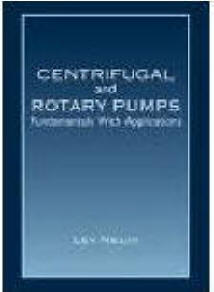
 Dr. Nelik has 30+ years experience with pumps and pumping equipment. He is a Registered Professional Engineer, who has published over fifty documents on pumps and related equipment worldwide, including a "Pumps" section for the Encyclopedia of Chemical Technology (John Wiley), a section for the Handbook of Fluids Dynamics (CRC Press), and a book "Centrifugal and Rotary Pumps: Fundamentals with Applications", by the CRC Press. He is a President of Pumping Machinery, LLC company, specializing in pump consulting, training, and equipment troubleshooting. His experience in engineering, manufacturing, and field troubleshooting includes: Ingersoll-Rand (Engineering), Goulds Pumps (Technology), Roper Pump (Vice President of Engineering, and Repair/Overhaul) and Liquiflo Equipment.